India’s Examination Fraud Crisis: 2005-2026
A Twenty-Year Analysis

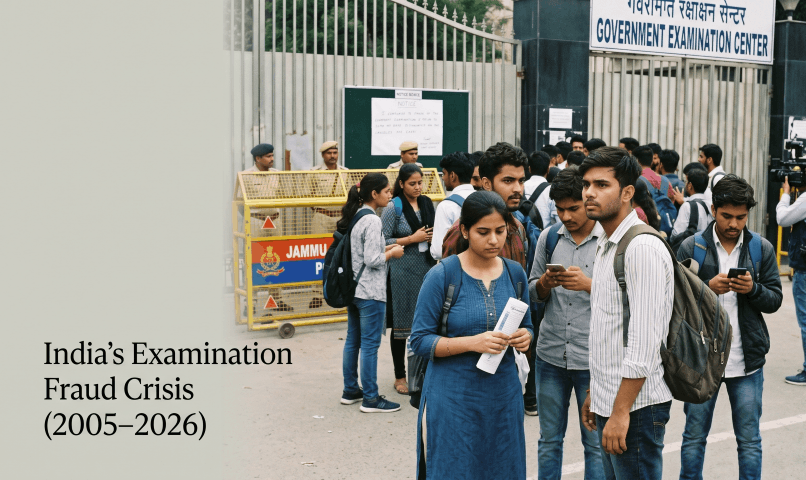
For millions of students across India, competitive examinations represent years of preparation, financial sacrifice, and the hope of stable employment. Yet over the last two decades, recurring paper leaks, organised cheating networks, result manipulation, and institutional failures have steadily eroded trust in the examination system.
Between 2005 and 2026, 220 documented examination fraud cases were identified across 21 states, affecting an estimated 9–10 crore students directly or indirectly. What emerges from these cases is not a series of isolated scandals, but a structural crisis spanning multiple governments, institutions, and examination bodies.
The issue has become especially visible in recent years through repeated controversies involving recruitment exams, NEET, UGC-NET, and other major competitive examinations.
Key Findings
- 220 documented examination fraud cases across 21 states between 2005–2026
- Approximately 9–10 crore students affected
- Paper leaks emerged as the dominant form of fraud after 2015
- Medical entrance examinations became one of the most repeatedly compromised exam clusters
- Multiple anti-paper leak laws introduced since 2022 have not significantly reduced recurring cases
- Despite large-scale investigations, criminal accountability remains extremely limited in most recent cases
Patterns of Failure
The nature of examination fraud has changed significantly over time. Earlier cases often involved impersonation or localised cheating networks, while recent years have seen large-scale paper leaks enabled through digital communication systems and compromised printing or distribution channels.
Repeated controversies across recruitment examinations, public service commissions, and medical entrance tests suggest deeper institutional vulnerabilities rather than isolated misconduct.
The crisis has also exposed serious weaknesses in investigative accountability. While examinations are occasionally cancelled or re-conducted after public pressure, convictions and long-term institutional reforms remain rare.
Public Impact
The consequences of examination fraud extend far beyond cancelled tests.
For students and families, competitive examinations often represent years of preparation, financial investment, and the possibility of social mobility. When examinations are compromised, delayed, or manipulated, the burden falls overwhelmingly on aspirants rather than institutions.
Repeated irregularities have also contributed to growing public distrust in merit-based recruitment and selection systems across the country.
What Must Change
The examination fraud crisis can no longer be treated as a collection of isolated criminal incidents. The repeated recurrence of paper leaks and compromised examinations points toward a deeper structural governance failure.
The movement continues to demand:
- Transparent and independently auditable examination systems
- Strong preventive safeguards across examination processes
- Time-bound and publicly accountable investigations
- Accountability of officials and institutions involved in irregularities
- Structural reforms to restore trust in competitive examinations
Read the Full Report
Access the complete 2005–2026 examination fraud crisis report.
Media Highlights